 English
 Čeština
 Français
 Deutsch
 polski
 Español
About lab-grown diamonds

From seed to diamond
A natural diamond seed is a small, perfectly clean crystal – usually a square plate measuring 1–2 mm – that serves as the foundation on which a new diamond grows. Only the cleanest and most stable stones, free from internal flaws or inclusions, are selected, so that growth is even. These stones are first laser-sawn into thin plates with the ideal crystallographic orientation (most commonly {100} or {111}). They are then thoroughly cleaned in an acid bath and by ultrasound to remove even microscopic impurities.
Each seed is then placed in a special metal or ceramic chamber that simulates the conditions deep within the Earth’s crust. In the HPHT method, a carbon source and a metal catalyst are added; in the CVD method, the seed is placed in a vacuum chamber containing a plasma of gases.
Under these conditions the seed is exposed to extreme pressure and temperature, or to active carbon atoms that settle on it and build up new layers of diamond. The process takes days to weeks and growth proceeds atom by atom until the seed has grown into a crystal of the required size. Once removed, the diamond is cleaned, inspected and then cut and polished in exactly the same way as a natural stone.
The result is a pure, real diamond – simply grown by man rather than by nature.
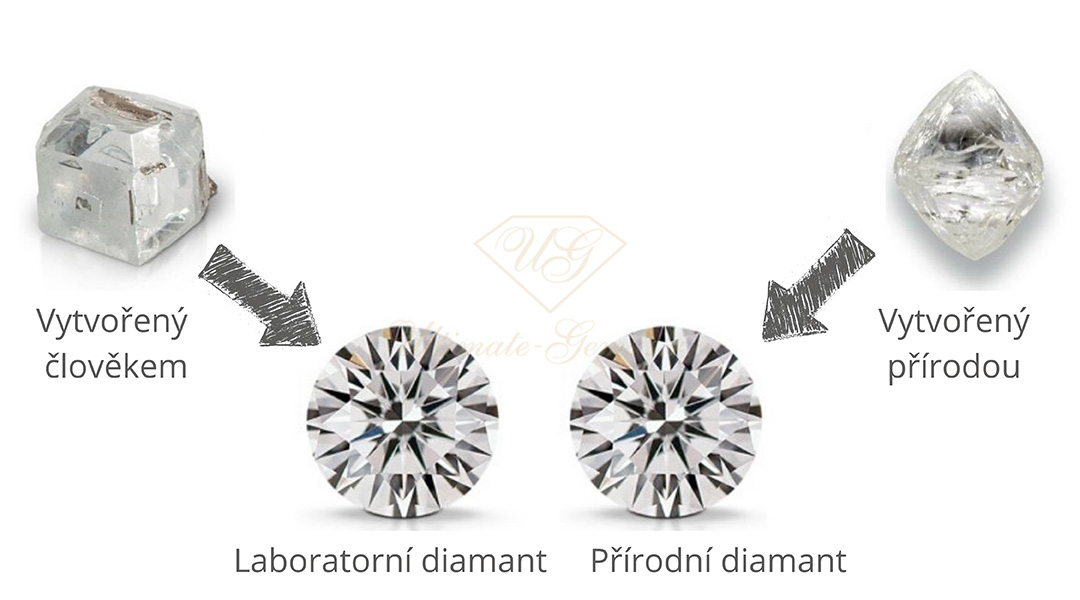
Indistinguishable to the eye
Laboratory-created diamonds (also referred to as lab-grown diamonds, synthetic diamonds, man-made diamonds or cultured diamonds) are diamonds created by man that are optically indistinguishable from diamonds created by nature.
Not even an experienced expert can tell a lab-grown diamond from a natural one by sight alone. Leaving aside the unique number borne by every certified lab-grown diamond, specialist equipment is needed to determine which stone is natural and which is lab-grown.
Lab-grown diamonds are composed of carbon atoms arranged in the same structure and therefore display the same chemical and optical properties as a natural diamond crystal formed by Mother Nature through geological processes.
A clear side-by-side comparison
We have prepared a quick, clear table for you comparing a selected natural diamond with a selected lab-grown diamond. They have exactly the same carat weight, D colour, VVS1 clarity and the best possible cut (the natural diamond graded by GIA, the lab-grown diamond graded by IGI).
Both diamonds were deliberately chosen for their very high quality grades and come close to perfect parameters. Even so, it must be said that these are in no way investment gemstones, as some diamond dealers claim.
We shall be pleased to prepare a special offer for you on a natural or a lab-grown diamond. We stand by our claim to have the best price on the market. We are ready to prove it at any time and to offer you a better price than the one at which a competitor is offering you the same diamond.
Write to us and together we will choose the right diamond for you!
Click on the table to enlarge it.

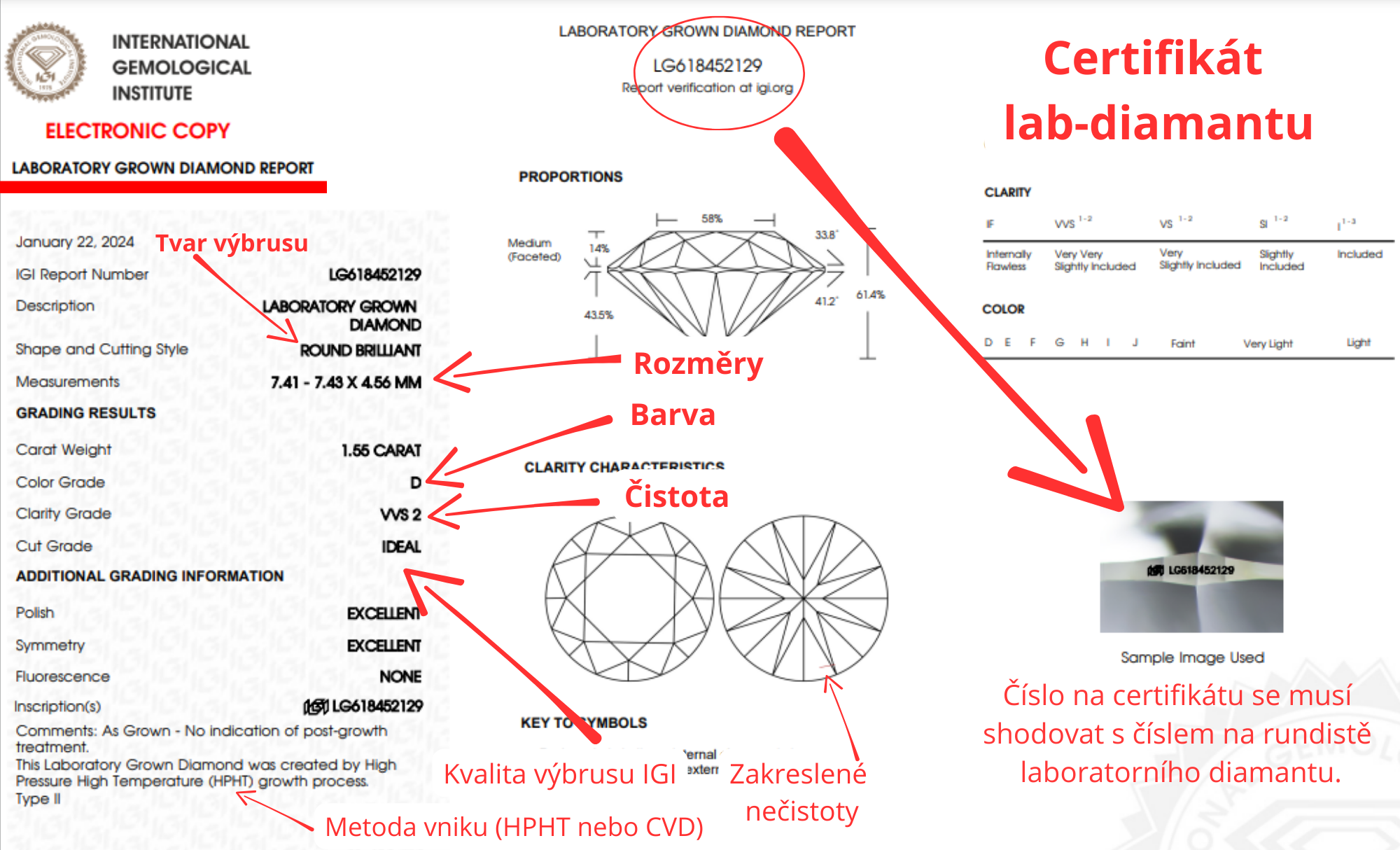
Certification of lab-grown diamonds
Lab-grown diamonds are certified in just the same way as natural diamonds. The grading reports therefore show all of the 4Cs (clarity, colour, carat, cut).
Important: Every lab-grown diamond with IGI certification (from 0.50ct) has a unique number laser-inscribed on its girdle, which you can verify quickly and easily at any time on the website of the laboratory that graded the diamond. There you will also find further information and reports, which you can download for your own use.
You can try it out with this lab-grown diamond. Simply copy the report number 618452129, paste it into the box and click ‘Verify’.
Link to the IGI website: https://www.igi.org/verify-your-report/

Colour | Grades and recommendations
The colour grading of most gem-quality diamonds is based on the absence of colour. A chemically pure and structurally perfect diamond has no hue, like a drop of pure water, and consequently has a higher value. The GIA diamond grading system grades diamond colour from D to Z. The degree of colourlessness is measured under controlled lighting and precise viewing conditions by comparison with master stones of established colour value. Many of these colour distinctions are so subtle that they are invisible to the untrained eye; nevertheless, they make a great difference to a diamond’s quality and price.
Clarity | Grades and recommendations
Diamond clarity refers to the absence of internal inclusions and external blemishes. Natural diamonds are the result of carbon being exposed to tremendous heat and pressure deep within the Earth. This process can give rise to a variety of internal characteristics called ‘inclusions’ and external characteristics called ‘blemishes’.
Grading a diamond’s clarity involves determining the number, size, relief, nature and position of these characteristics, as well as how they affect the overall appearance of the stone. Although no diamond is perfectly pure, the closer it comes, the higher its value. With only slight exaggeration, one might say that a diamond’s clarity and its flaws are its unique fingerprint, much like a human one.
The GIA diamond clarity scale has 6 categories, some of which are subdivided, giving a total of 11 specific grades.
Flawless (FL) – No inclusions and no blemishes visible under 10× magnification
Internally Flawless (IF) – No inclusions visible under 10× magnification
Very, Very Slightly Included (VVS1 and VVS2) – Inclusions so slight that they are difficult for a skilled grader to see under 10× magnification
Very Slightly Included (VS1 and VS2) – Inclusions are visible with effort under 10× magnification, but can be characterised as minor
Slightly Included (SI1 and SI2) – Inclusions are noticeable under 10× magnification
Included (I1, I2 and I3) – Inclusions are obvious under 10× magnification and may affect transparency and brilliance
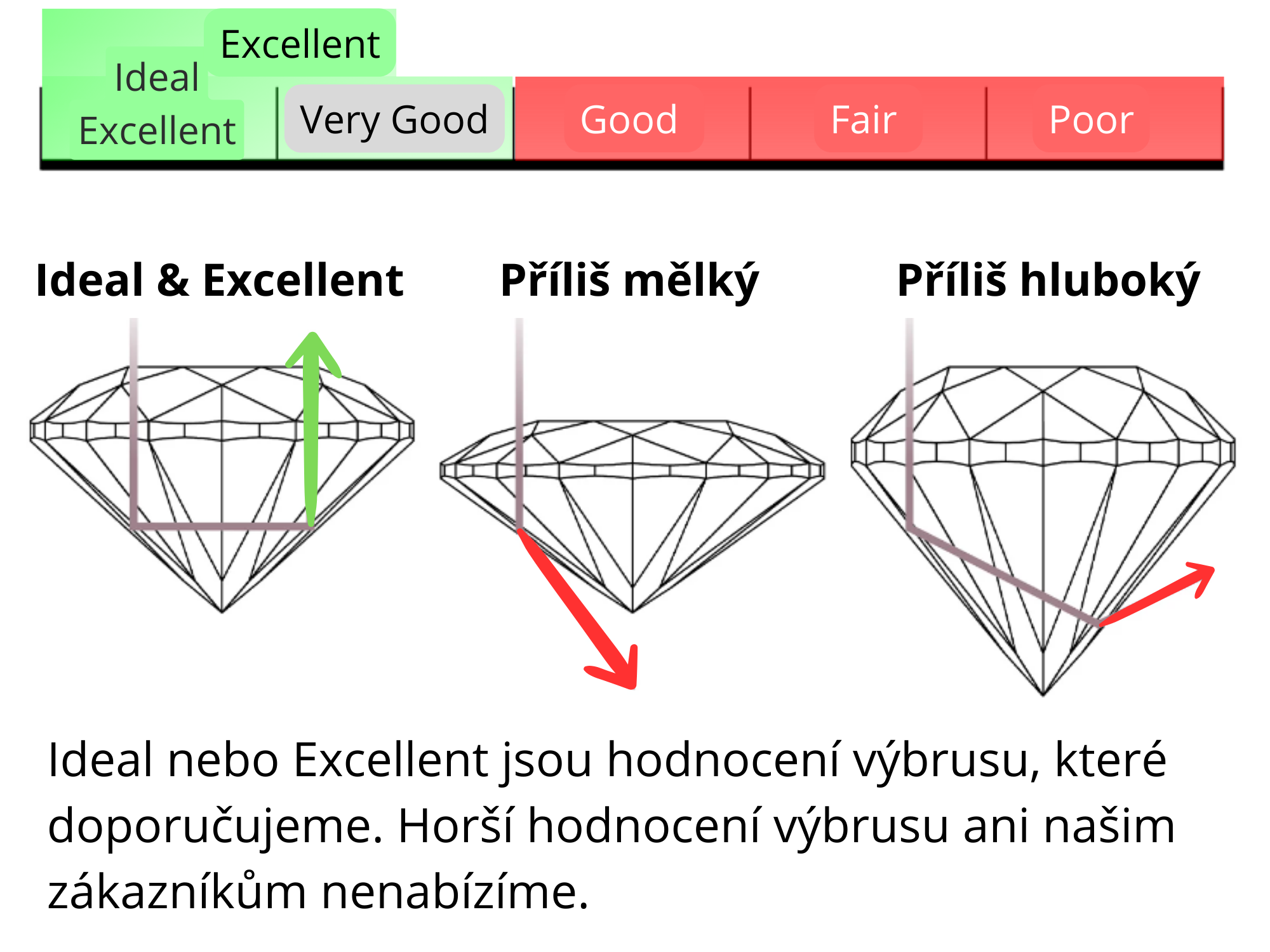
Cut | Grades and recommendations
A diamond’s cut – sometimes also called its make – is the way in which the diamond has been cut, faceted and finished to achieve maximum lustre, brilliance and beauty. Cut quality is one of the most significant factors influencing a diamond’s overall appearance and value.
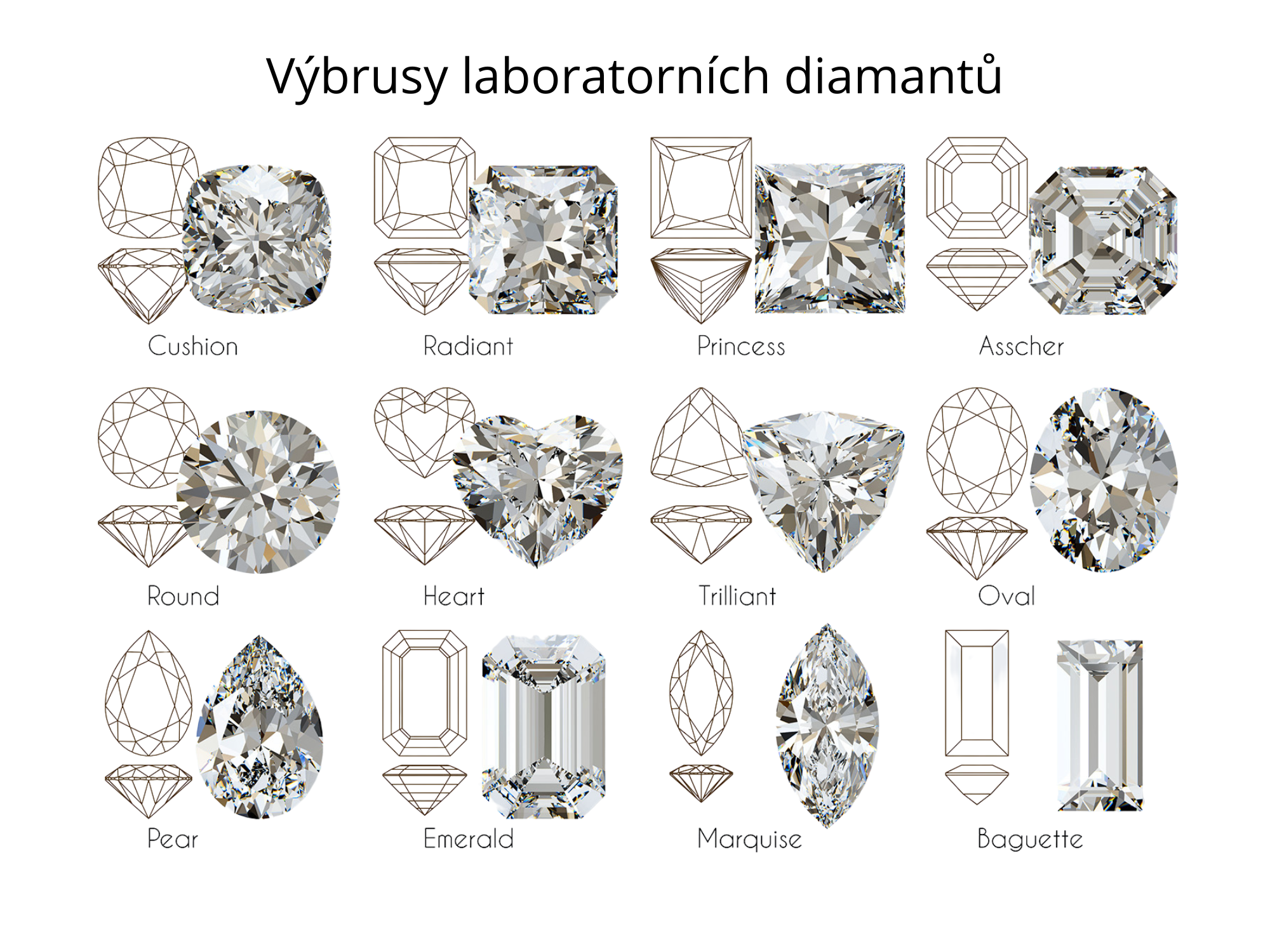
Diamonds come in a number of different shapes, including round, princess (square), emerald (step-cut) and many more. Each shape has its own unique aesthetic qualities and suits different kinds of jewellery.
Cut quality is assessed on the basis of several factors, including proportions (the diamond’s length, width and depth), symmetry (the evenness and precision of the shape) and polish (the smoothness of the surface). An ideal cut achieves maximum reflection and refraction of light, producing a bright and sparkling brilliance.
A diamond’s cut may be graded on a scale on which the highest grades are designated ‘Excellent’ or ‘Ideal’, while lower grades may be, for example, ‘Very Good’, ‘Good’ or ‘Fair’. Cut quality has a fundamental influence on a diamond’s overall beauty.
All the IGI-certified lab-grown diamonds we offer attain AGS 000 Hearts & Arrows cut quality. This is a cut that achieves some of the very best results in terms of a diamond’s brilliance.
Hearts & Arrows cut | The symmetry of hearts and arrows
Viewed from above (through the crown), an ideally cut diamond should reveal eight symmetrical arrows. Viewed from below (through the pavilion), it should show eight symmetrical hearts.
Thanks to the extreme level of cutting skill and precision required to produce these symmetrical patterns, Hearts & Arrows diamonds have outstanding light performance and precise optical symmetry.
The IGI-certified lab-grown diamonds we supply have a Hearts & Arrows cut, while smaller stones (0.80mm – 4.00mm) have a classic brilliant cut.
Important: cut specification of the round brilliant lab-grown diamonds we supply
IDEAL | EXCELLENT | EXCELLENT
IDEAL is the highest cut grade awarded by IGI (whereas at GIA the highest grade is Excellent). When it comes to cut, we make no compromises.
From seed all the way to diamond
Man-made diamonds begin with a small piece of diamond known as a diamond seed. The seed is sealed inside a special chamber designed to mimic the conditions within the Earth’s crust. Coated in pure carbon, the seed eventually turns into a synthetic diamond that is chemically identical to a natural diamond.
Our laboratory experts select diamond seeds of the highest quality. It is very important to choose seeds free from any imperfections. The best seeds are carefully positioned on a metal disc, which is placed in special equipment capable of creating the conditions in which lab-grown diamonds grow. The apparatus in which lab-grown diamonds are produced is called a ‘diamond growth chamber’ or a ‘diamond growth reactor’.
How lab-grown diamonds are made: the methods
What is interesting about the process itself is the conditions under which laboratory-created diamonds are formed. They do not, in fact, differ from the process by which natural diamonds form. The one fundamental difference is that one process takes place naturally in the earth over billions of years, whereas the other takes only a few weeks in a laboratory. From a scientific point of view, however, it remains one and the same.
Creating a diamond requires carbon, extreme heat and extreme pressure. The effect of that heat and pressure on the carbon triggers the process that produces the beautiful gemstones we know as diamonds.
Two specific methods are used to create lab-grown diamonds: High Pressure High Temperature (HPHT) and Chemical Vapour Deposition (CVD).
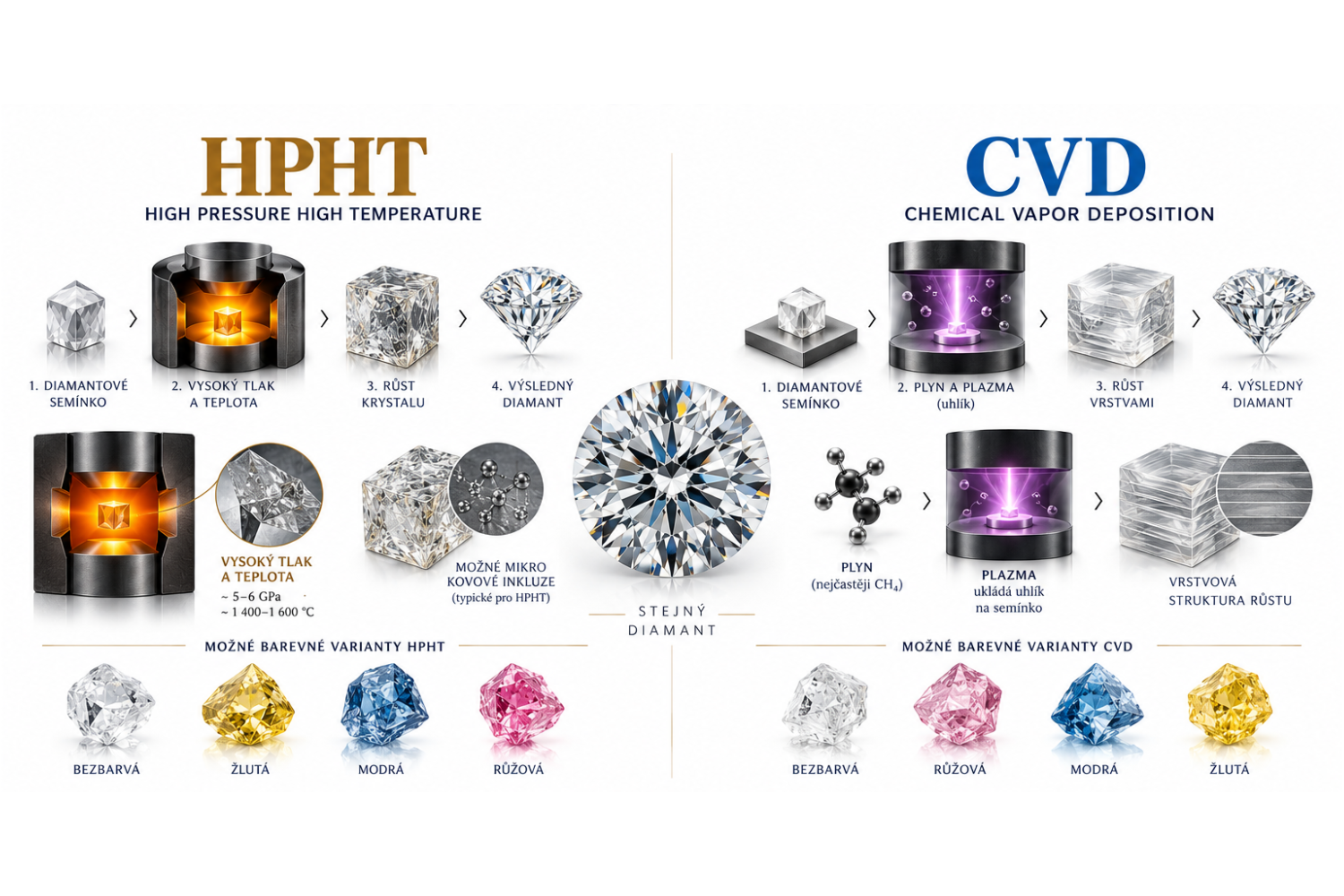
Diamonds created by the High Pressure High Temperature (HPHT) method:
The HPHT method begins with a small piece of diamond called a diamond seed. The seed is placed in pure carbon and then subjected to heat and pressure that mimic the conditions deep within the Earth’s crust.
A temperature of around 1,500 degrees Celsius (2,700 degrees Fahrenheit) and a pressure of 1.5 million pounds per square inch dissolve the layer of carbon, forming a finished diamond around the original diamond seed. In essence, the carbon is dissolved and broken down by the heat, then solidifies under pressure (which transforms it into diamond) and is subsequently cooled.
Several different machines are commonly used to apply heat and pressure in the HPHT process – the belt press, the cubic press and the split-sphere (BARS) press. The last of these is the most common today, as it is the most efficient way of growing diamonds, larger diamonds in particular.
Diamonds created by Chemical Vapour Deposition (CVD):
The CVD method – short for Chemical Vapour Deposition – uses less heat and far lower pressure than HPHT. Instead, carbon-based gases are used to form and grow the diamond.
The process again begins with a diamond seed. The seed for the CVD process is usually a thin slice of diamond, often one that was itself first created by the HPHT method.
As with the HPHT method, the diamond seed is placed in a sealed chamber. Gases, usually methane and hydrogen, are then introduced into the chamber. The environment is next heated to several hundred degrees Celsius. At this temperature the gases break down, and the carbon atoms from the gases begin to build up around the diamond seed.
The CVD method is newer and less costly than HPHT, because the machines are smaller and require less energy. However, diamonds created by CVD often come out black or brown in colour, which calls for subsequent HPHT treatment to obtain a final colourless diamond. Even so, the CVD method has improved markedly over the past decade, which means that it is increasingly common to produce colourless diamonds by Chemical Vapour Deposition alone.
Carat weight
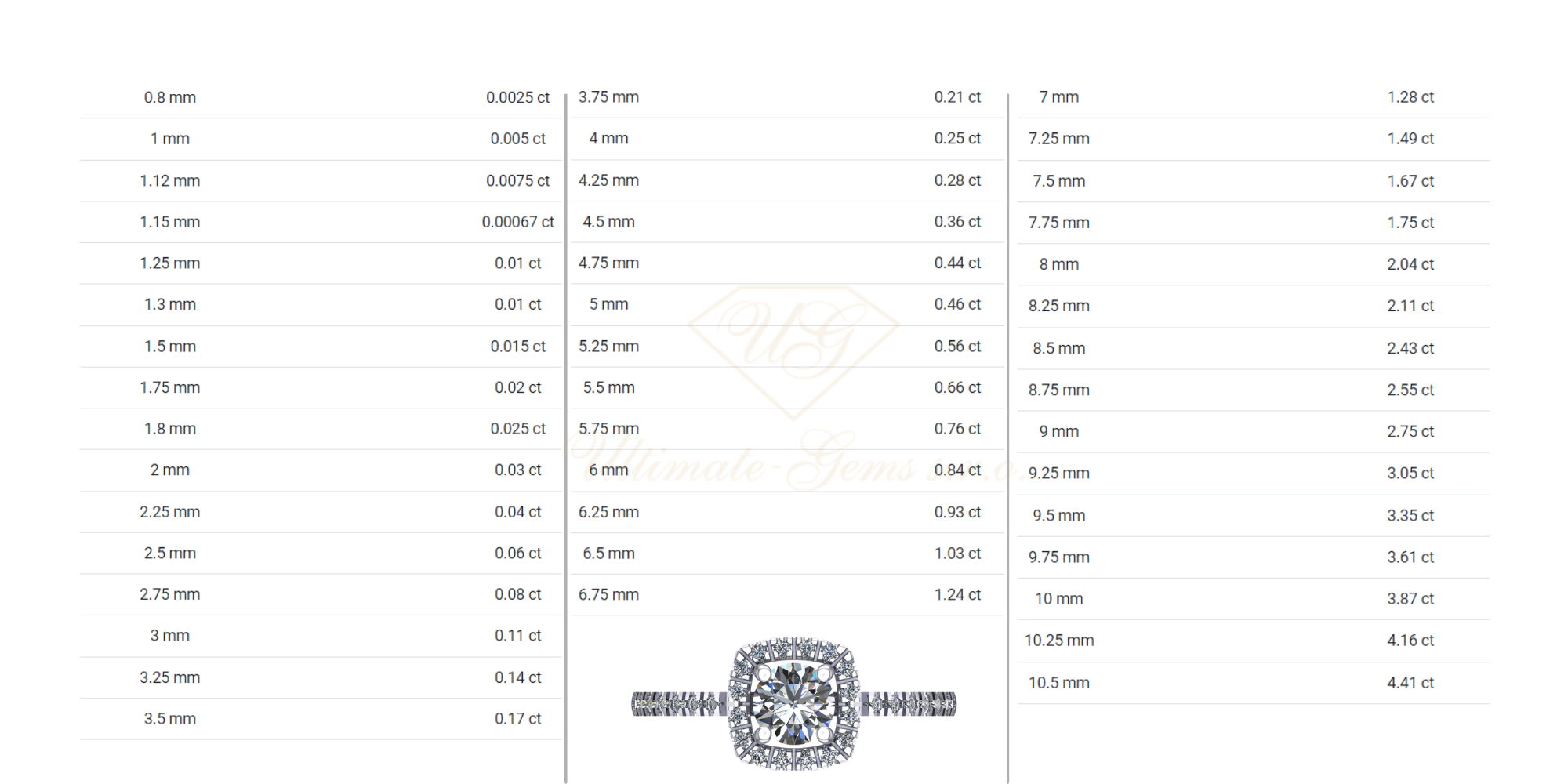
A diamond’s carat weight is one of the key factors determining its value and size. One carat is equal to 0.2 grams, or 200 milligrams. This figure expresses the mass of the diamond and represents the amount of material contained in the stone. Here are a few important facts about diamond carat weight:
- Significance for size: Carat weight has a great bearing on a diamond’s overall size. The higher the carat weight, the larger and heavier the diamond.
- How carats are stated: Diamond weights are commonly given in whole carats and decimal fractions of a carat – for example, 1.05ct or 0.50ct.
- Size and price: Larger diamonds are generally more expensive than smaller diamonds of the same quality characteristics. A diamond’s size can have a significant influence on its overall value.
- Visual impression: Interestingly, a diamond’s weight does not always reflect its apparent size. Diamonds can differ depending on their cut, which affects how large and how brilliant they appear to the eye.
- Weight and categories: Carat weight is also used to classify diamonds into different weight categories, such as a ‘half-carat diamond’ or a ‘2-carat diamond’.
Most people choose diamonds on the basis of their carat weight, but it is also important to take into account the other factors – clarity, colour and cut – which together determine a diamond’s overall quality.

How lab-grown diamonds are made: the methods
What is interesting about the process itself is the conditions under which laboratory-created diamonds are formed. They do not, in fact, differ from the process by which natural diamonds form. The one fundamental difference is that one process takes place naturally in the earth over billions of years, whereas the other takes only a few weeks in a laboratory. From a scientific point of view, however, it remains one and the same.
Creating a diamond requires carbon, extreme heat and extreme pressure. The effect of that heat and pressure on the carbon triggers the process that produces the beautiful gemstones we know as diamonds.
Two specific methods are used to create lab-grown diamonds: High Pressure High Temperature (HPHT) and Chemical Vapour Deposition (CVD).
Buy an IGI-certified lab-grown diamond
Looking for somewhere to buy a lab-grown diamond safely? We offer certified lab-grown diamonds with IGI certification and clearly stated 4C parameters. Every stone is either physically in stock or, for non-stock items, quickly available to order according to the customer’s wishes (various cuts, colours, clarities and cut grades tailored to your budget).
Lab-grown diamonds in stock – overview of parameters
For every diamond we state:
-
Carat weight (e.g. 0.5 ct, 1.0 ct, 2.0 ct, right up to 30.0 ct)
-
Cut quality – we work only with the very highest cut grades, which guarantee the diamond’s maximum brilliance.
-
Colour (D–F) | We recommend E colour, which falls within the colourless range and shows no trace of an unwanted yellowish tint.
-
Clarity (IF–VVS2) | For diamonds up to 1.50ct, VVS1 offers good value, whereas above 1.50ct VVS2 does. Both VVS1 and VVS2 are very high clarity grades.
-
IGI report number | Every customer can verify the report number at any time on the IGI website: IGI Verify my report
This allows you to compare individual lab-grown diamonds by both price and quality. You can read more about lab-grown diamonds in our section about lab-grown diamonds.
The price of a lab-grown diamond
The price of a lab-grown diamond depends primarily on the combination of its 4C parameters. Compared with mined diamonds, lab-grown diamonds allow you to obtain a greater carat weight or a higher clarity at a far lower price.
On this page you will find our current range of diamonds with transparent pricing and no hidden charges.
Who is a loose diamond suitable for?
A loose lab-grown diamond is the ideal choice if:
-
you are planning a bespoke engagement ring, or wish to have the stone set in any piece of jewellery from our range
-
you are choosing a diamond according to specific parameters
-
you are looking for the best price-to-size ratio
- you are one of those who admire the unique beauty of diamonds
Why buy a lab-grown diamond from us?
 IGI certification for every stone over 0.50ct Clearly stated 4C parameters Diamonds in stock & short delivery times for non-stock stones Individual consultation on your choice, a personal approach and expert advice Safe purchase from an established Czech company trading since 2012
Choose a lab-grown diamond to suit your requirements and filter the range by carat, colour, clarity or price.
Never seen a lab-grown diamond before? If you have seen a natural one, a lab-grown diamond looks exactly the same. You can also view one on our YouTube channel, where you can find plenty of inspiration.